By Tracy McBeth Writer

6 minute read
Published 15 February 2026
Exercise often comes with delayed rewards. Enjoyable activities like music or audiobooks deliver instant pleasure.2
By pairing the 2, your brain starts to associate movement with something positive right away.
Tracy McBeth Writer
Tracy is a journalist with a passion for promoting good health, both mentally and physically.
By Tracy McBeth Writer
Exercise can boost your brain as much as your body, but those long-term benefits are a hard match against the snooze button at 6 am.
If exercise feels hard to stick to, it’s likely not because you’re lazy or lack discipline. Behavioural science shows that your brain is wired to prioritise immediate rewards over long-term benefits.1
And many of the benefits of exercise, like better health or fitness, take time to show up.
The good news is that you can work with your brain instead of against it.
Temptation bundling2 means pairing something you should do, like exercise, with something you want to do, like:
This approach was popularised by behavioural scientists and has been shown to help people exercise more consistently.2
When enjoyable experiences consistently happen during exercise, your brain learns that movement predicts a reward.
Research shows that people who experience a higher enjoyment of exercise tend to have stronger exercise habits and intend to exercise more often.3
This shows pairing exercise with something to make it more enjoyable can reduce resistance and make exercise feel less like a chore.
Willpower is limited and easily depleted, especially when you’re tired, stressed or busy.4
Temptation bundling lowers the mental effort required to start moving. Instead of asking, “Do I feel motivated?”, you’re thinking, “I want to hear the next chapter.”
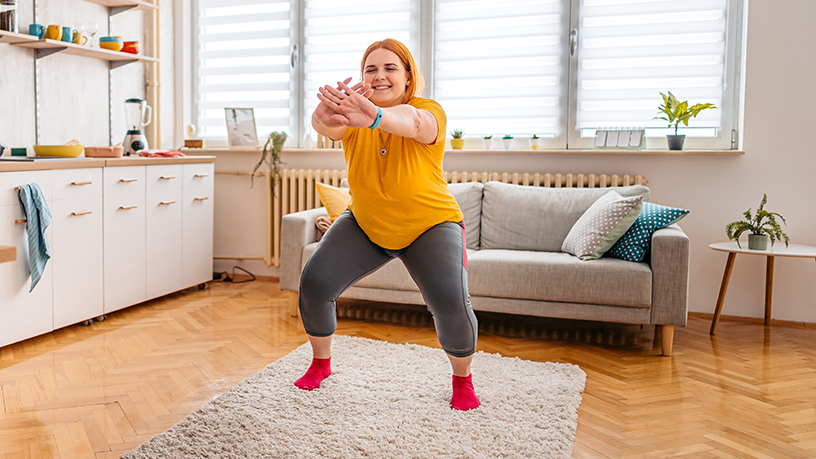
You don’t need a gym membership or intense workouts to try this approach. Small, realistic habits matter.
You might try:
The key is choosing something you genuinely enjoy.
Research consistently shows that people are more likely to stick with exercise when it feels enjoyable and achievable.5 You don’t need to push yourself to exhaustion for movement to be beneficial.
Regular, moderate activity can support:6
Finding ways to make movement pleasant increases the chance you’ll keep coming back.
If exercise has felt hard in the past, that doesn’t mean you’ve failed. It means your brain is doing what it’s designed to do.
Using behavioural science strategies like temptation bundling is one way to design your environment to support you, rather than relying on motivation alone.
Sometimes, the most effective changes are also the simplest.
At Bupa, trust is everything
Our health and wellbeing information is regularly reviewed and maintained by a team of healthcare experts, to ensure its relevancy and accuracy. Everyone's health journey is unique and health outcomes vary from person to person.
This content is not a replacement for personalised and specific medical, healthcare, or other professional advice. If you have concerns about your health, see your doctor or other health professional.
1 Burghoorn, F., Scheres, A., Monterosso, J., Guo, M., Luo, S., Roelofs, K., & Figner, B. (2025). Pavlovian impatience: The anticipation of immediate rewards increases approach behaviour. Cognitive, Affective, & Behavioral Neuroscience, 25(3), 358–376.
2 Milkman, K. L., Minson, J. A., & Volpp, K. G. (2014). Holding the hunger games hostage at the gym: An evaluation of temptation bundling. Management Science, 60(2), 283–299.
3 Teixeira, D. S., Rodrigues, F., Cid, L., & Monteiro, D. (2022). Enjoyment as a predictor of exercise habit, intention to continue exercising, and exercise frequency: The intensity traits discrepancy moderation role. Frontiers in Psychology, 13, 780059.
4 Baumeister, R. F., André, N., Southwick, D. A., & Tice, D. M. (2024). Selfcontrol and limited willpower: Current status of ego depletion theory and research. Current Opinion in Psychology, 60, Article 101882.
5 ColladoMateo, D., DomínguezMedina, S., Adsuar, J. C., MerellanoNavarro, E., Gusi, N., & Olivares, P. R. (2021). Immediate enjoyment is a key predictor of long-term adherence to physical activity: A systematic review. International Journal of Environmental Research and Public Health, 18(4), 1907.
6 Australian Government Department of Health, Disability and Ageing. (2021). About physical activity and exercise.
Discover how micro workouts can help you stay fit when you’re short on time. Learn the benefits, drawbacks, and easy examples to move more every day.
You’ve probably heard that 10,000 steps a day is important for your health, but have you ever stopped to ask why?
Health information can be confusing, complex and at times seem contradictory. But what if you could step towards a longer, healthier life just by moving more?
There are people who love exercising... and then there's the rest of us. We’ve put together 8 things you can try to make exercise fun and get moving.
Bupa acknowledges and shows respect to the Traditional Custodians of Australian land. We pay our respects to Elders past and present and recognise their cultural heritage, beliefs, and continuing connection to land, waters, and community. We embrace their knowledge on how to protect and nurture these lands, and all they contain, to keep this country and people healthy.